All orders

Order

Flagship

/ship-issue

autonomous ticket delivery

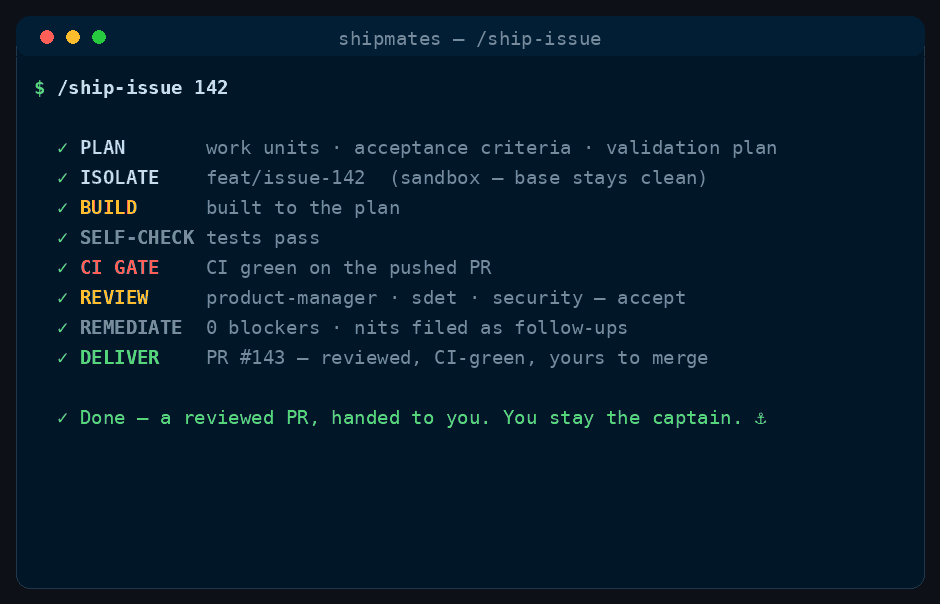
Take a GitHub issue/story from open → reviewed PR (→ merged, opt-in) autonomously — worktree, subagent build, CI gate, specialist acceptance board, follow-up issues.

Take issue / story #<issue> from open all the way to a reviewed, CI-green pull request on the base branch, autonomously — using an isolated git worktree and a board of specialist subagents. Merging is gated by MERGE_MODE (see Config): by default the run stops with the PR open for a human to merge; set MERGE_MODE=auto for fully hands-off delivery.

Input ($ARGUMENTS): the first whitespace-delimited token is the issue / story number (<issue> below); everything after it is extra guidance from the caller (may be empty).

How to run it

Run it in Claude Code

/ship-issue <issue-or-story-number> [optional extra guidance]

<angle brackets> = required · [square brackets] = optional

Step by step

The stages

Eleven stages, in order. One is a hard gate — the run stops there until it passes.

  1. Stage 0 — Intake & plan

    Crew: (agent: Plan)

    1. Resolve the number: gh issue view <issue> --json number,title,body,labels,url. If <issue> is a "story number" that differs from the GitHub issue number, map it via the epic checklist issue or the README scope table, then confirm the real issue number.
    2. Spawn ONE Planner (subagent_type: Plan). Give it the full issue body + repo README + CLAUDE.md. Ask it to return, as structured data:
      • a build plan broken into independent work units with non-overlapping file ownership (so builders can run in parallel without collisions),
      • explicit, checkable acceptance criteria (functional + the quality bar above), including the project's Definition of Done where it states one (tests, docs/changelog, non-functional bars),
      • a test/validation plan (the commands the SDET should run: unit tests, lint, type-check, build/compile/import — whatever this repo uses),
      • a list of files expected to change,
      • domain classification flags that decide which specialists the board pulls (set each independently — a story can trip more than one):
        • IS_UI_STORY = yes/no — does it create/modify on-screen UI (screens, HUD, panels, overlays, menus, components, styling)? Gates ux-ui-designer.
        • IS_VISUAL_STORY = yes/no — gate the art-director on the PROJECT'S DOMAIN, not merely on whether a story touches pixels. Set it only when the project's actual deliverable is rendered visual art — a game's world/sprites/shaders, illustration/brand/motion assets, generative imagery — and this story touches it. A conventional app (finance, media, SaaS, dev-tooling) whose only visual surface is its interface is a UI story (ux-ui-designer), NOT an art story: the art-director reviews pictures judged as art, not application chrome. Most projects never set this — when in doubt, prefer IS_UI_STORY and leave the art-director out.
        • IS_ARCH_SIGNIFICANT = yes/no — does it add a new subsystem, change a persisted data/schema format, or cross-cut many modules in a way a narrow code review would miss? Gates architect.
        • IS_SECURITY_SENSITIVE = yes/no — does it touch authn/authz, untrusted input, secrets/credentials, crypto, file/network/OS access, or dependencies? Gates security-engineer.
    3. If the plan reveals the issue is too big/ambiguous to finish autonomously, stop and tell the user what's blocking — otherwise continue.
  2. Stage 1 — Isolate

    Crew: (orchestrator, deterministic — no agent)

    git -C <repo> fetch origin
    git -C <repo> worktree add <WORKTREE_DIR> -b <BRANCH> origin/<BASE_BRANCH>

    All build/fix work happens inside <WORKTREE_DIR> so the base branch and the user's checkout stay clean. Pass the absolute worktree path to every agent.

  3. Stage 1.5 — Design specs

    Crew: (specialist agents — each only if its flag is set)

    BEFORE any Builder runs, spawn whichever apply, in parallel (a story can need more than one). Each writes NO code — it returns a spec document, fed verbatim to every Stage 2 Builder whose files its work governs. Skip this stage entirely when none of the flags are set.

    • ux-ui-designer (only if IS_UI_STORY) — a UI design spec: wireframes, a shared-token/theme plan, responsive container layout (no hardcoded positions), focus order + interaction states, and accessibility/contrast, consistent with the project's design system.
    • art-director (only if IS_VISUAL_STORY) — a concrete, numeric art direction (palette values, dimensions, light angle/ratio — whatever the medium needs) held to the project's visual bar, so a Builder implements what's meant, not a guess.
    • architect (only if IS_ARCH_SIGNIFICANT) — the structural approach: module boundaries and ownership, and the schema/versioning/migration strategy if persisted data changes.
  4. Stage 2 — Build

    Crew: senior-engineer (agents: senior-engineer × N, parallel)

    • Spawn one Builder (subagent_type: senior-engineer) per independent work unit from the plan, in a single message so they run concurrently. Each Builder is told: its exact file ownership, the acceptance criteria it must satisfy, the worktree path, any Stage 1.5 spec that governs its files, and to match existing code style/idioms.
    • Builders write code only — they do not commit, push, or open PRs (the orchestrator owns git).
    • After they report done, verify the files on disk yourself (Read/Grep). Never trust a "done" report blindly.
  5. Stage 3 — Self-check before PR

    Crew: sdet (agent: sdet)

    • Spawn the SDET (subagent_type: sdet) to run the test/validation plan against the worktree: unit tests, linters, type-checks, and — if the toolchain exists — a real build/compile step (whatever this repo uses: e.g. npm test && npm run build, cargo test, pytest -q, go build ./..., make check). If the toolchain is absent, it does a rigorous static pass and says so explicitly in the PR.
    • If self-check fails, loop a Fixer (subagent_type: senior-engineer) until green (counts toward MAX_FIX_ROUNDS). Only open a PR once self-check passes — never open a known-red PR.
  6. Stage 4 — Commit, push, open PR (orchestrator)

    git -C <WORKTREE_DIR> add -A
    git -C <WORKTREE_DIR> commit -m "<type>: <summary> (#<issue>)"   # + required trailers
    git -C <WORKTREE_DIR> push -u origin <BRANCH>
    gh pr create --base <BASE_BRANCH> --head <BRANCH> \
      --title "<type>: <issue title> (#<issue>)" \
      --body  "<what changed, how validated, 'Closes #<issue>', trailers>"

    The PR body must include: summary, the acceptance criteria as a checklist, how it was validated (and any validation that could NOT be run locally), and Closes #<issue>.

  7. Stage 4.5 — CI gate: wait for green, fix if red (orchestrator + Fixer)

    Gate: HARD GATE

    When there is no local toolchain to fully validate, CI is the ONLY real runtime gate — the Stage 3 SDET pass is static and WILL miss things (parse errors, lint-as-error, dependency/version drift). You MUST confirm CI is green on the pushed head before the acceptance board runs. Never assume a push is green. (If the repo has no CI, say so and treat the SDET pass as the gate, explicitly noting the reduced assurance.)

    1. Wait for the checks to finish on the PR head (poll, don't guess):
      until s=$(gh pr checks <PR#> 2>&1 | head -1); st=$(echo "$s" | awk '{print $2}'); \
        [ "$st" != "pending" ]; do sleep 15; done; echo "$s"

      (Long-running: launch as a background command / until-loop so you're notified on completion — do not chain foreground sleeps.)

    2. If any check FAILS, pull the actual failure log — do not speculate:
      gh run view <run-id> --log-failed | grep -iE "FAIL|error|Parse|::error" | head -60

      Diagnose the real cause from the log. Before pushing a fix, grep the whole changeset for sibling instances of the same failure class so you fix them all in one round instead of burning several.

    3. Dispatch a Fixer (subagent_type: senior-engineer; or fix directly if it's a trivial, unambiguous one-liner you've root-caused from the log) in the worktree, commit with the required trailers, push to the same branch. This counts toward MAX_FIX_ROUNDS.
    4. Re-poll CI (back to step 1) on the new head. Repeat until green or MAX_FIX_ROUNDS is exhausted — if still red after that, stop and escalate to the user with the failure log; do not proceed to acceptance on a red PR.
    5. Only once CI is green do you proceed to Stage 5. Carry the confirmed-green run link into the final report.
  8. Stage 5 — Acceptance board

    Crew: (specialist agents, reviewing the PUSHED PR head)

    Spawn these in parallel against the PR head commit (they review exactly what will merge). The two core reviewers always run; each specialist runs only when its flag is set:

    • product-manager (always): checks every acceptance criterion AND the quality bar (from the repo's README/CLAUDE.md). Returns ACCEPT / ACCEPT-WITH-NITS / REJECT with specifics per criterion.
    • sdet (always): re-runs the validation plan against the PR branch; returns PASS / FAIL with a severity-tagged defect list.
    • ux-ui-designer (only if IS_UI_STORY): reviews the pushed head against the Stage 1.5 spec and the UI bar — shared-token/theme usage (not per-component override sprawl), responsive layout, focus navigation, interaction states, contrast/readability. If it cannot actually render the UI, it reviews statically and MUST flag the PR "needs a human visual pass" — carry that into the report.
    • art-director (only if IS_VISUAL_STORY): renders the actual change via the project's render/preview harness (if one exists) and reviews the produced output against the Stage 1.5 direction and the visual bar — the render, not the source. If it cannot render, it says so and flags "needs a human visual pass".
    • architect (only if IS_ARCH_SIGNIFICANT): reviews structural fit, coupling/blast radius, and schema/migration safety.
    • security-engineer (only if IS_SECURITY_SENSITIVE): threat-models the change (STRIDE / OWASP) — broken access control, injection, secrets/crypto, vulnerable deps — and returns severity-ranked findings with the exploit path; a credible Critical/High is a blocking defect.

    Decision (each specialist participates only when its flag is set):

    • All spawned reviewers ACCEPT/PASS (nits allowed) → go to Stage 7.
    • Any REJECT / FAIL → Stage 6.
  9. Stage 6 — Remediation loop

    Crew: senior-engineer (agent: senior-engineer as Fixer)

    • Spawn a Fixer (subagent_type: senior-engineer) to address every blocking item (REJECT reasons from any Stage 5 reviewer + FAIL defects). Commit + push to the same branch. Then re-run Stage 5 on the new head.
    • Repeat up to MAX_FIX_ROUNDS. If still not green after that, stop and escalate to the user with the outstanding blockers — do not merge a failing PR.
  10. Stage 7 — Follow-up issues (orchestrator)

    • Take every non-blocking nit (from any "WITH-NITS" verdict and low-severity SDET findings) and file each as its own GitHub issue: gh issue create with a priority:low / tech-debt label (create the label if missing), a clear title, context, and a link back to this PR.
    • Do NOT let nits block delivery; they become tracked follow-ups.
  11. Stage 8 — Deliver (orchestrator)

    • If MERGE_MODE=manual (default): stop here. Post a completion comment on the PR (what shipped, how validated, the green CI link, follow-ups filed) and hand the user the PR link to merge. Leave the worktree in place, or remove it and keep the branch — your choice, state which.
    • If MERGE_MODE=auto: gh pr merge <BRANCH> --squash --delete-branch, then confirm the issue auto-closed (else gh issue close), tick the epic checklist box if any, remove the worktree (git -C <repo> worktree remove <WORKTREE_DIR>), and post the completion comment.

Final report to the user

One concise summary: PR link (and merge state), commit(s), which specialists reviewed it and their verdicts, number of fix rounds, follow-up issues filed (with links), the confirmed-green CI link, and anything that could only be validated statically.

Config (defaults — override only if the repo clearly needs it)

  • BASE_BRANCH = the repo's default branch (gh repo view --json defaultBranchRef -q .defaultBranchRef.name).
  • MERGE_STRATEGY = --squash --delete-branch
  • MERGE_MODE = manualmanual: stop after the acceptance board with a green, reviewed PR open for a human to merge. auto: squash-merge automatically once every gate passes. Start with manual; opt into auto only in a repo where unattended merges to the base branch are acceptable.
  • MAX_FIX_ROUNDS = 3 (acceptance→fix→re-acceptance loops before escalating to the user)
  • WORKTREE_DIR = a sibling of the repo root: ../<repo>--issue-<issue>
  • BRANCH = feat/issue-<issue>-<short-slug>
  • Quality bar = whatever the repo's README / CLAUDE.md / contributing docs state. Read it at the start and pass it to every reviewer — the product-manager (and the visual specialists) enforce THAT bar, not just "it runs."

Required commit trailers (append to every commit and the PR body — read them from the harness / session context; do not invent them). At minimum a Co-Authored-By: line for the agent.

The reviewer/builder pool

Every specialist below is a named subagent shipped alongside this command (.claude/agents/*.md, installed globally or per-project) and invoked by its subagent_type — NOT a general-purpose agent with a persona pasted inline. The pool:

subagent_typeUsed for
senior-engineerBuilding, fixing, remediation (Stages 2, 3, 4.5, 6)
sdetTest / build / validation runs (Stages 3, 5)
product-managerAcceptance vs. criteria + the quality bar (Stage 5)
architectStructural / schema review — gated by IS_ARCH_SIGNIFICANT (Stages 1.5, 5)
ux-ui-designerOn-screen UI design + review — gated by IS_UI_STORY (Stages 1.5, 5)
art-directorVisual-art direction + review — art-producing domains only, gated by IS_VISUAL_STORY (Stages 1.5, 5)
security-engineerThreat-model + security review — gated by IS_SECURITY_SENSITIVE (Stage 5)

These agents are generic (domain-neutral); the project-specific standard they enforce comes from your repo's README / CLAUDE.md, passed at spawn — not baked into the role. Which specialists a story needs is decided by the Planner's classification flags, so the board is context-aware to the story's domain (a pure-logic story pulls no designer/art-director; a UI story pulls the designer; a rendered-art story pulls the art-director; a schema story pulls the architect). If a referenced role does not resolve to a .claude/agents/*.md, fall back to general-purpose with the role's brief inlined, and note the fallback in the final report — never silently skip a gated review.

Guardrails

  • The orchestrator owns all git/gh actions; agents never push or merge.
  • Reviewers always evaluate the pushed PR head, so "accepted" == "what merges".
  • Never open or advance a red PR. Never skip the SDET run. Never silently drop a nit — file it.
  • Never assume a push is green. After every push (Stage 4 and every Stage 6 fix), run the Stage 4.5 CI gate: poll gh pr checks until done, and if red pull gh run view --log-failed, fix, re-push, re-poll. The static SDET pass does NOT substitute for a confirmed-green CI run.
  • Keep the base branch and the user's working tree untouched throughout (all work in the worktree).
  • Respect MERGE_MODE — do not auto-merge unless it is explicitly set to auto.
  • If genuinely blocked (ambiguous scope, unsatisfiable hard gate, a missing toolchain the test plan requires), stop and surface it — autonomy does not mean forcing a bad merge.
  • Secrets & security hygiene. Never write secrets, tokens, or credentials into commits, PR/issue bodies, or logs — assume the repo is public. When the change touches auth, input handling, crypto, or dependencies, the security-engineer (gated by IS_SECURITY_SENSITIVE) threat-models it and the sdet also flags secret leakage; a real leak or a clear injection path is a blocking defect.
  • Be resumable. A re-run may find the worktree, branch, or PR already exists — reuse them rather than erroring or duplicating work. Every stage should be safe to repeat.
  • Static review cannot verify pixels. When neither the ux-ui-designer (UI) nor the art-director (visual-art) could actually render and inspect the result, surface their "needs human visual pass" flag in the final report rather than implying the visuals are confirmed. Both are auto-gated by the Planner's IS_UI_STORY / IS_VISUAL_STORY flags, as architect is by IS_ARCH_SIGNIFICANT.

Where this lives

This page is generated from skills/ship-issue/SKILL.md. The installer copies it to ~/.claude/skills/ship-issue/SKILL.md for every project, or .claude/skills/ship-issue/SKILL.md inside a single repo.

View skills/ship-issue/SKILL.md on GitHub