Order
/plan-epics
briefs → GitHub epics + user stories
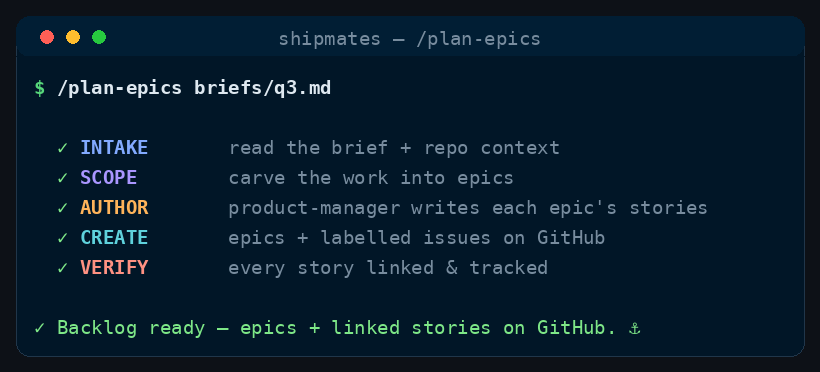
Turn a brief (or several) into a tracked backlog — GitHub epics + linked, labelled user stories, with a product-manager subagent authoring each epic's stories in parallel.
Turn the brief(s) in $ARGUMENTS into a tracked backlog: one or more epics (labelled epic), each broken into user stories (labelled user-story + area tags), created as GitHub issues and cross-linked. When the work spans multiple epics, a product-manager subagent authors each epic's stories in parallel — one PM per epic.
Input ($ARGUMENTS): the brief(s). May be inline text, a path to a file/dir of briefs, or several briefs separated by --- or numbered. If it's empty, ask the user for the brief before doing anything.
How to run it
Run it in Claude Code
/plan-epics <brief text | path to a brief file | several briefs> [area/label hints] [dry-run]
<angle brackets> = required · [square brackets] = optional
Step by step
The stages
Five stages, in order.
-
Stage 0 — Intake & context (orchestrator)
- Parse
$ARGUMENTSinto one or more briefs; read any referenced files/dirs. - Gather repo context so the backlog fits the project:
README/CLAUDE.md(domain, conventions, quality bar),gh label list, and the existing open issues (gh issue list --state open --limit 300 --json number,title,labels) so you can dedupe against work already tracked. - Decide the shape: does the brief map to one cohesive epic, or several independent ones? (A brief naming multiple distinct capabilities → multiple epics.)
- If a brief is too vague to scope responsibly, ask the user ONE round of clarifying questions before creating anything — don't invent a backlog from thin air.
- Parse
-
Stage 1 — Scope into epics
Crew:
product-manager(agent:product-manager, one)Spawn ONE
product-managerwith all briefs + the Stage 0 context. It returns the epic set (writes no issues) — for each epic: a crisptitle, thewhy/goal (the outcome, not the output), high-levelscopeand non-goals,dependencies/build-order between epics, and suggestedarealabel(s). One brief may yield one epic; that's fine. -
Stage 2 — Author each epic's stories
Crew:
product-manager(agents:product-manager× N, parallel)Spawn one
product-managersubagent per epic, in a single message so they run concurrently. Give each: its epic (title/why/scope), the full repo context, the OTHER epics' titles (for cross-epic dependencies), and the existing-issues list (to dedupe). Each returns its epic's user stories as structured data (noghcalls) — per story:title(short, outcome-shaped),description(the user value: "As a … I want … so that …" where it fits),- acceptance criteria — explicit and checkable, Given/When/Then where natural,
arealabel(s), and dependency order (blocked_byother stories where real).
Tell each PM: stories should be INVEST (independent, negotiable, valuable, estimable, small, testable) — one shippable slice each, vertically sliced over horizontal layers, dependency-ordered, and NOT duplicating an existing open issue. Prefer a handful of well-formed stories over a long shallow list. To avoid clobbering, each PM returns its data inline (no shared temp filenames).
-
Stage 3 — Create the issues (orchestrator, deterministic)
If
DRY_RUN: print the epic→story tree (titles, criteria, labels, order) and STOP.Otherwise, in this order (numbers must exist before they're referenced):
- Labels — ensure
epic,user-story, and any neededarea:*exist (gh label createthe missing ones; note which you created). Don't spam the namespace — only labels you'll actually use. - Epics first —
gh issue createeach epic: body = the why/goal + scope/non-goals + a story checklist placeholder + cross-epic dependency notes + the trailer +epiclabel. Capture each epic's issue number. - Stories —
gh issue createeach story: body = description + acceptance criteria +Part of #<epic>+Blocked by #<n>where known + the trailer +user-storyand area labels. Capture each story number. - Backfill the epic checklists — edit each epic body, replacing the placeholder with
- [ ] #<story>lines for its stories, so the epic tracks its children and GitHub cross-links them.
- Labels — ensure
-
Stage 4 — Verify & report
- Verify every story carries
Part of #<epic>matching its epic, and every epic's checklist lists all its stories (re-fetch and grep; don't assume). - Report a tree: each epic (title + link) → its stories (title + link), with counts, any labels created, a recommended build order, and anything skipped as an existing duplicate.
- Verify every story carries
Config (defaults — override only if the repo clearly needs it)
REPO= current repo (gh repo view --json nameWithOwner -q .nameWithOwner).EPIC_LABEL=epic;STORY_LABEL=user-story(create if missing).AREA_LABELS= derived from the repo's existinggh label list(prefer thearea:*family). Create a new area label only when a story clearly needs one that doesn't exist — and say which you created.- Issue-body trailer:
Claude-Session: ...on every epic and story (read from the harness/session context; do not invent). DRY_RUN= on if the caller says "dry run" / "preview": print the full plan and create NOTHING.
Guardrails
- The orchestrator owns all
ghcalls; theproduct-manageragents only return structured story data — they never create issues themselves. - Dedupe. Never re-file work already tracked in an open issue; note what you skipped and why.
- Don't over-scope. A brief becomes the smallest coherent set of epics/stories that delivers it — no speculative epics the brief didn't ask for.
- Respect
DRY_RUN— when set, create nothing. - Every epic and story must be individually valuable and traceable (
Part of #), so the backlog is ready to hand to/ship-issueone story at a time. - If a role doesn't resolve to a
.claude/agents/*.md, fall back togeneral-purposewith the product-manager brief inlined, and note the fallback.
Where this lives
This page is generated from skills/plan-epics/SKILL.md. The installer copies it to ~/.claude/skills/plan-epics/SKILL.md for every project, or .claude/skills/plan-epics/SKILL.md inside a single repo.